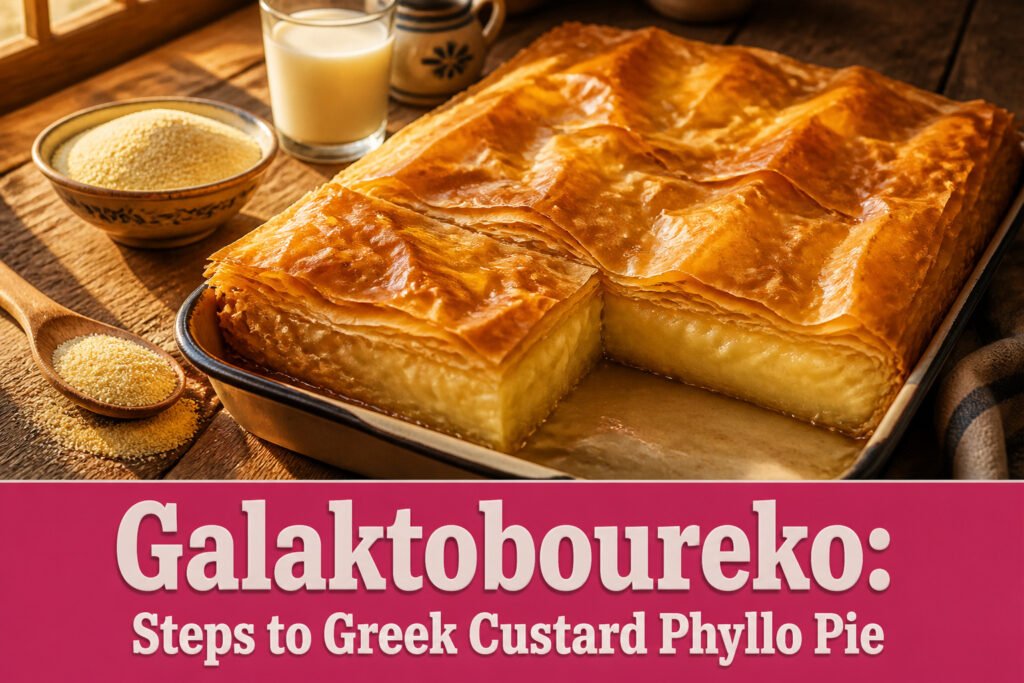
Galaktoboureko is a Greek custard pie built from semolina pudding sandwiched between buttered phyllo sheets, then soaked in cold syrup after baking. The catch is timing: the syrup must be fully cool when it meets the hot pastry, or the crisp layers collapse into sogginess. Most recipes call for six cups of milk and a cup of fine semolina, and the custard needs just enough heat to set firm enough for clean slicing without turning grainy.
What Galaktoboureko Is and Where It Comes From
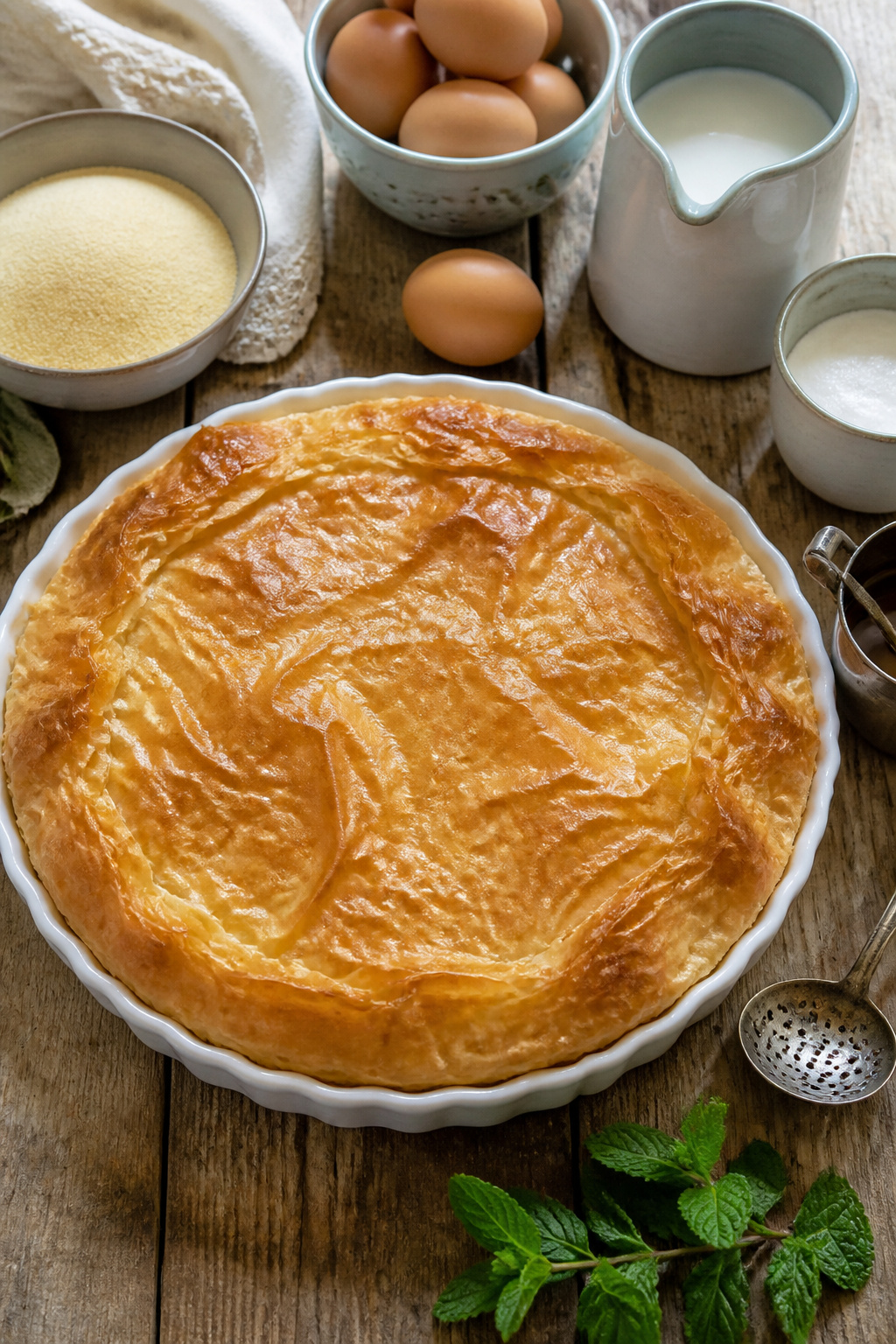
Galaktoboureko is a custard-filled dessert built from three parts: layers of phyllo pastry, a semolina-based custard, and a sweet syrup poured over after baking. The name itself breaks down neatly; "galakto" means milk in Greek and "börek" is the Turkish word for a filled pastry, which points to the dish’s layered history across the region.
The custard at its center is traditionally made with semolina, though some versions use muhallebi, a milk pudding with ancient roots that also appears in Turkish cooking. Phyllo sheets sandwich this filling top and bottom, and the whole construction gets drenched in syrup once it comes out of the oven. That soaking step places galaktoboureko in the family of Greek desserts called siropiasta, which includes better-known pastries like baklava.
Regional versions shift the details. In Cyprus, the same dessert goes by galatopourekko. The eastern Black Sea region of Turkey calls it laz böreği. The core architecture stays constant even as the name and small particulars change.
Galaktoboureko is made with a type of pudding called muhallebi or semolina custard.
That flexibility in the custard base matters for home cooks. Semolina is what most Greek recipes specify and what you’ll find at any grocery store, but knowing muhallebi is an accepted alternative tells you the dessert is forgiving rather than rigidly codified.
1. The Semolina Custard

The semolina custard starts with six cups of milk, one cup of fine semolina, six eggs, and one cup of sugar. Some cooks add butter to the pot early; others stir it in at the end. Both approaches work, though starting with butter gives the custard a slightly richer mouthfeel.
Heat the milk with the sugar and semolina first, stirring until the mixture thickens to a pudding-like consistency. This takes roughly five to ten minutes depending on your burner. The semolina is what separates this custard from a standard egg-based one: it sets firm enough to slice cleanly once baked, but still yields a soft, creamy bite rather than the wobble of crème caramel.
Remove the pot from heat and let it cool slightly before adding the eggs. Beat them separately, then temper by whisking in a small ladle of the hot semolina mixture to bring their temperature up slowly. Pour the warmed eggs back into the pot and return to medium-low heat, stirring constantly until the custard thickens again. Stop too early and the filling will weep into the phyllo; go too long and you risk graininess. A teaspoon of vanilla extract or vanilla powder rounds out the flavor without competing.
2. Phyllo Layering

A 9-by-12-inch pan gets the job done, though a 9 1/2-by-13 works too. Brush the bottom and sides with melted unsalted butter before the first sheet touches it. Cover the remaining phyllo with a damp cloth the moment you open the package; this dough tears the second it dries out, and a damp towel buys you the time to work carefully.
Fresh phyllo is ideal if you can find it, but frozen is what most of us have. Thaw it overnight in the refrigerator, not on the counter. Ten to fourteen sheets form the base, butter brushed between each one. Some cooks layer two sheets at a time with butter every other layer, building up to sixteen sheets on the bottom. Either way works; the two-at-a-time method is faster and wastes less butter.
Phyllo sold abroad tends to be the "phyllo kroustas" type, a crusty filo dough. Thickness varies by brand, and that is fine. Tear a sheet? Piece it together and keep going. The butter and baking will fuse it into one flaky mass. Do not skimp on the butter. It looks excessive brushed across ten or twelve sheets, but this is what separates crisp layers from a sodden stack.
3. Filling and Top Crust

Pour the warm custard over your buttered phyllo base while it is still loose enough to level itself with a gentle shake of the pan. The filling should settle into an even layer about an inch deep, leaving whatever overhang you built along the edges free and clear.
Lay the top phyllo the same way you did the bottom: one sheet at a time, butter between each, letting the edges drape over the sides. Once the last sheet is down, fold those overhanging edges inward one by one, tucking them over the filling like a closed envelope. The corners end up with the most layers, which is exactly where you want the extra crunch.
Score the top with a serrated knife and a ruler, cutting only through the phyllo, not down to the custard. Twelve even squares is the usual division. Those shallow cuts let steam escape so the pastry does not dome or crack, and they give you clean break lines once the pie is baked and syrupy. A few drops of water sprinkled over the scored top before it goes in is optional, though some cooks swear it turns the phyllo lacier.
4. Baking
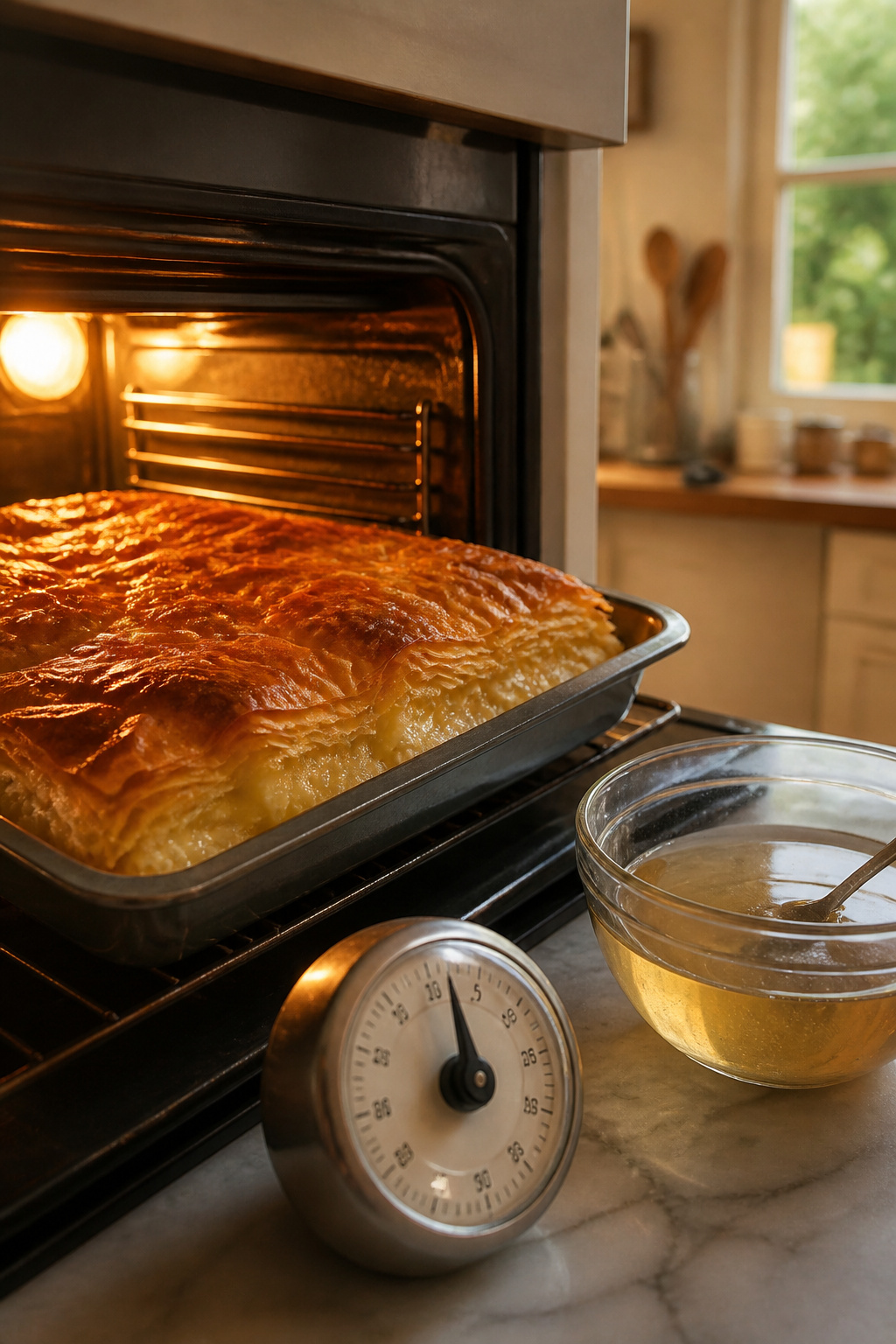
The oven temperature is where recipes split. Some call for 350°F, others for 375°F, and both produce a finished pie. The lower heat gives the custard more time to set before the phyllo darkens; the higher heat yields a cracklier, more deeply browned top in exchange for closer watching. I have settled on 350°F when the custard layer is thick, 375°F when I have built the pie shallower and want the contrast.
Bake until the top is golden brown with patches of deeper bronze at the ridges, not merely pale yellow. That color signals that the butter in the phyllo has fully cooked out its moisture and the layers have separated into crisp sheets. In my oven this takes roughly 50 minutes, though I start checking at 45 and have let it run past 60 when the top seemed hesitant. The range is real, not a hedge: phyllo thickness varies, ovens drift, and a cold custard straight from the refrigerator will need longer than one still warm from the pot.
5. The Syrup

Sugar syrup for galaktoboureko starts simple: one and a half cups sugar, one cup water, and a quarter cup of lemon juice. I add a cinnamon stick and a few lemon slices or some zest while it boils, which gives the finished pie a warmth underneath the sweetness. The sugar dissolves in a few minutes of boiling, then the syrup comes off the heat and sits until it is completely cool.
The syrup must be cold when it meets the hot pastry. This temperature difference is what keeps the phyllo from going soggy. Hot syrup over hot phyllo collapses the crisp layers into something limp; cold syrup over hot phyllo lets the liquid absorb while the structure stays intact. I spoon it on slowly, right in the pan, letting each ladleful sink in before adding the next. The pie takes what it can hold, usually not every drop.
6. Serving and Storing

Cold syrup poured over hot pastry is the move that keeps the top layers crisp. The temperature difference lets the liquid absorb without turning the phyllo limp, so add it one ladleful at a time and let each pour sink in before the next. I sometimes end up with a ladleful left over; that is normal.
Wait at least an hour before cutting. The custard needs time to set, and the syrup needs time to travel. Room temperature or slightly warmed is the best way to serve it. Refrigerating to cool is a mistake, it softens the crust you just protected.
For storage, the refrigerator is fine for 3 to 5 days, though the top will lose its crackle no matter what. Reheat gently if you want it warm again. It will still taste good; it just will not sound the same when your fork goes in.
Phyllo Thickness and Type

Fresh phyllo sheets thawed overnight in the fridge separate cleanly and stay pliable through assembly. Frozen phyllo works if that is what your store stocks, though it can turn soggy after thawing and may crack more easily. In Greece, dessert recipes call for either "phyllo kroustas," the standard crusty type, or the thinner "vyritou" style made with eggs. For galaktoboureko, the standard thickness builds a sturdy base and top that still shatter when cut.
| Attribute | Fresh Phyllo | Frozen Phyllo |
|---|---|---|
| Thawing needed | None | Overnight in fridge |
| Texture risk | Dries quickly if uncovered | Can turn soggy after thaw |
| Workability | Stays pliable longer | More fragile, handle gently |
Butter matters as much as the dough itself. Clarified butter reaches a higher smoke point than regular unsalted butter, so the layers brown evenly without burning. That said, unsalted butter melted and brushed between every sheet still gives you the flaky, crisp separation that defines the dessert. Each sheet must be buttered individually, or the layers fuse into a single dense shell. If you are working in a warm kitchen, keep the stack covered with cling film or a clean towel, not a damp cloth, to stop the phyllo from drying out and crumbling on you.
Custard Texture Fixes

Semolina custard can go wrong in three ways, and each one leaves you with a fixable problem rather than a ruined pie. Too runny means the semolina did not have enough time to bloom; keep it on the heat another minute or two, stirring constantly, until it coats the back of a spoon and a finger dragged through it leaves a clean line. Too thick, and the custard will fight the phyllo instead of settling into it; thin it with a splash of warm milk off the heat, a tablespoon at a time, until it spreads like loose yogurt. Grainy texture comes from semolina that hydrated unevenly, which happens when the heat jumps too fast; the only repair is a fine-mesh strainer, pressed through right after cooking, or better prevention next time by whisking the semolina into cold milk before you ever light the burner.
The eggs are the part that actually breaks. Dump hot custard straight into beaten yolks and you get sweet scrambled eggs; temper them slowly, whisking a thin stream of hot custard into the eggs until the bowl feels warm, then pouring that mixture back into the pot. Two bowls, two minutes, no curdling.
North American semolina runs coarser than what Greek recipes assume. If the box you found looks more like cornmeal than fine sand, blitz it in a blender for thirty seconds, or swap in corn starch for a smoother set that still slices clean. Farina works too, though it softens faster and can go from right to loose in a blink; drop the heat and watch it closer.
Individual Rolls and Other Shapes

Individual rolls change the assembly more than the flavor. Cut the phyllo sheets in half from the narrow side, brush with butter, and spoon two to three tablespoons of custard about 4 to 6 cm below the edge. Fold one side over the custard, then the other, and roll the rest into a cylinder roughly 10 cm long. Nest them seam-down in the baking tray so they hold each other in place.
The smaller shape means faster baking and a higher ratio of crisp edge to creamy center. A pan galaktoboureko needs the top and bottom layers to set before the custard finishes; rolls expose more surface area and the phyllo browns quicker. Start checking at least five minutes earlier than the pan version, and pull them once the pastry turns deep gold rather than waiting for uniform color across a flat top.
The syrup works the same either way. Pour it over the hot rolls right out of the oven so the pastry stays crisp underneath while the custard soaks up sweetness. The only real tradeoff is volume: you will need more phyllo sheets for the same number of servings, and the rolling takes longer than layering. For a dinner party where plates move to the table separately, the portioning wins. For a buffet where guests serve themselves, the pan still holds together better.
Timing and Oven Setup

350°F gives you a softer custard center and more forgiving window, while 375°F sets the top faster and can push the interior to that barely-set stage in closer to 45 minutes. I have seen recipes split right down the middle on this, and the truth is both work if you watch the pie rather than the clock.
At 350°F, the range stretches closer to 55–60 minutes. The phyllo browns more gradually, which matters if your top layer went on a little uneven. At 375°F, start checking at 40 minutes. The danger is a dark top with custard still soup underneath, so if the surface looks done and the center jiggles like a liquid, tent foil and give it another 8–10 minutes.
The real sign to pull it is a slight wobble in the center, not a wave. The edges should look set and the top should be deeply golden, not pale blonde. A knife inserted an inch from the rim should come out mostly clean. It will firm up as it cools, so pulling it early beats leaving it in until the center reads fully solid.
What You Need Before Starting

Phyllo dough, fine semolina, whole milk, eggs, sugar, unsalted butter, vanilla, lemon, and a cinnamon stick cover everything. No stand mixer, no pastry brush you do not already own, no hunting through specialty aisles.
- One box of phyllo, usually 1 lb with 10–14 sheets. Thaw frozen phyllo overnight in its packaging on the counter; cold sheets crack when you unroll them.
- Fine semolina, not coarse. The finer grind keeps the custard smooth rather than gritty. Sources vary between 1 cup and 2 cups for a full pan; the smaller amount suits a lighter-set custard, the larger one a firmer slice.
- Whole milk, 6 to 8 cups depending on whose recipe you follow. Skim works in a pinch, though the custard loses some richness.
- 3 to 6 large eggs. More eggs mean a denser, more set filling; fewer keep it softer and more delicate.
- Granulated sugar, split between the custard and the syrup. Expect roughly 1 cup inside and 1 1/2 cups for the syrup.
- Unsalted butter, about 2 sticks total. Melt it; you will brush it between every phyllo layer.
- Vanilla extract or powdered vanilla. Powdered keeps the custard pale; extract darkens it slightly but is what most home cooks already have.
- Lemon zest or peel, plus juice for the syrup. Some recipes add orange instead; lemon is the more common choice.
- One cinnamon stick for the syrup. It perfumes without speckling the way ground cinnamon would.
For equipment, a standard 9×13-inch pan, a medium saucepan, and a whisk are enough. A second saucepan for the syrup saves time if you have one, but it is not required.
Frequently Asked Questions
What is galaktoboureko?
Galaktoboureko is a Greek custard-filled dessert built from three parts: layers of phyllo pastry, a semolina-based custard, and a sweet syrup poured over after baking. The name combines the Greek word for milk, ‘galakto,’ with the Turkish word for filled pastry, ‘börek.’ It belongs to a family of Greek desserts called siropiasta, which are soaked in syrup.
How do I prevent the phyllo from getting soggy after adding the syrup?
Pour cold syrup over the hot pastry right after it comes out of the oven. That temperature gap lets the syrup absorb without collapsing the crisp layers. Spoon it on one ladleful at a time, giving each pour time to sink in before adding the next.
How long does galaktoboureko last in the fridge?
It keeps for 3 to 5 days refrigerated, though the top will soften no matter what. Eat it at room temperature or gently reheated for the best texture.