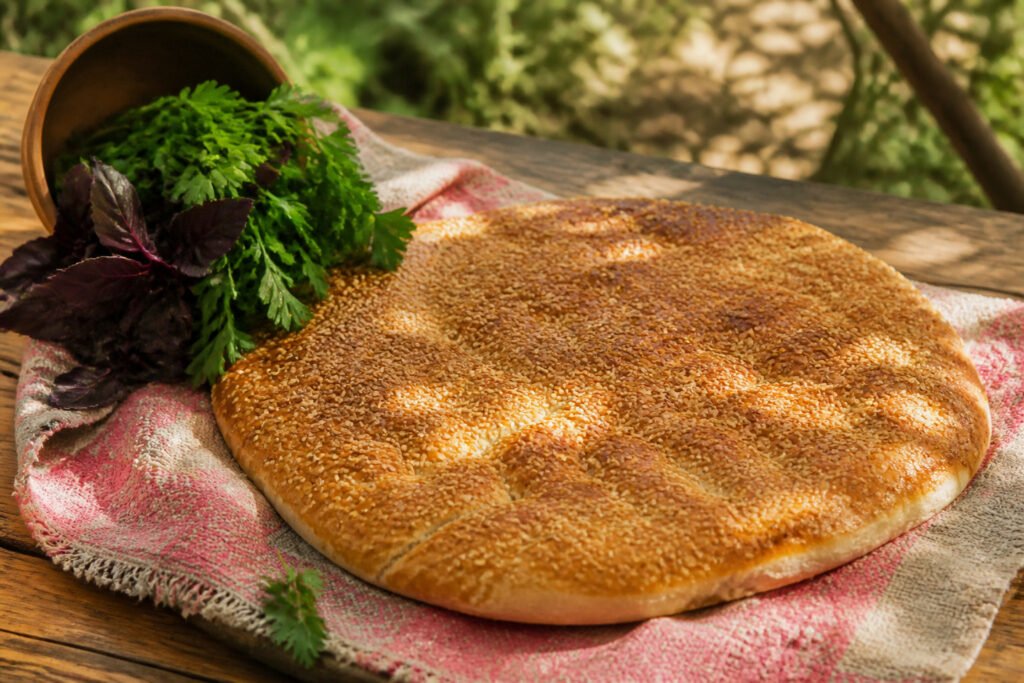
Lagana is a lean, sesame-crusted Greek flatbread baked once a year for Clean Monday, the Orthodox holiday that opens Great Lent. The catch is its four-hour rise: most flatbreads move faster, but that slow proof is what builds the open crumb and depth of flavor the bread is known for. Even Aristophanes named it, writing in the Ecclesiazusae that "lagana pettettai," lagans are made, a detail that still fits the hand-stretched, hand-torn loaf families eat in parks while kites fly overhead.
What Lagana Is
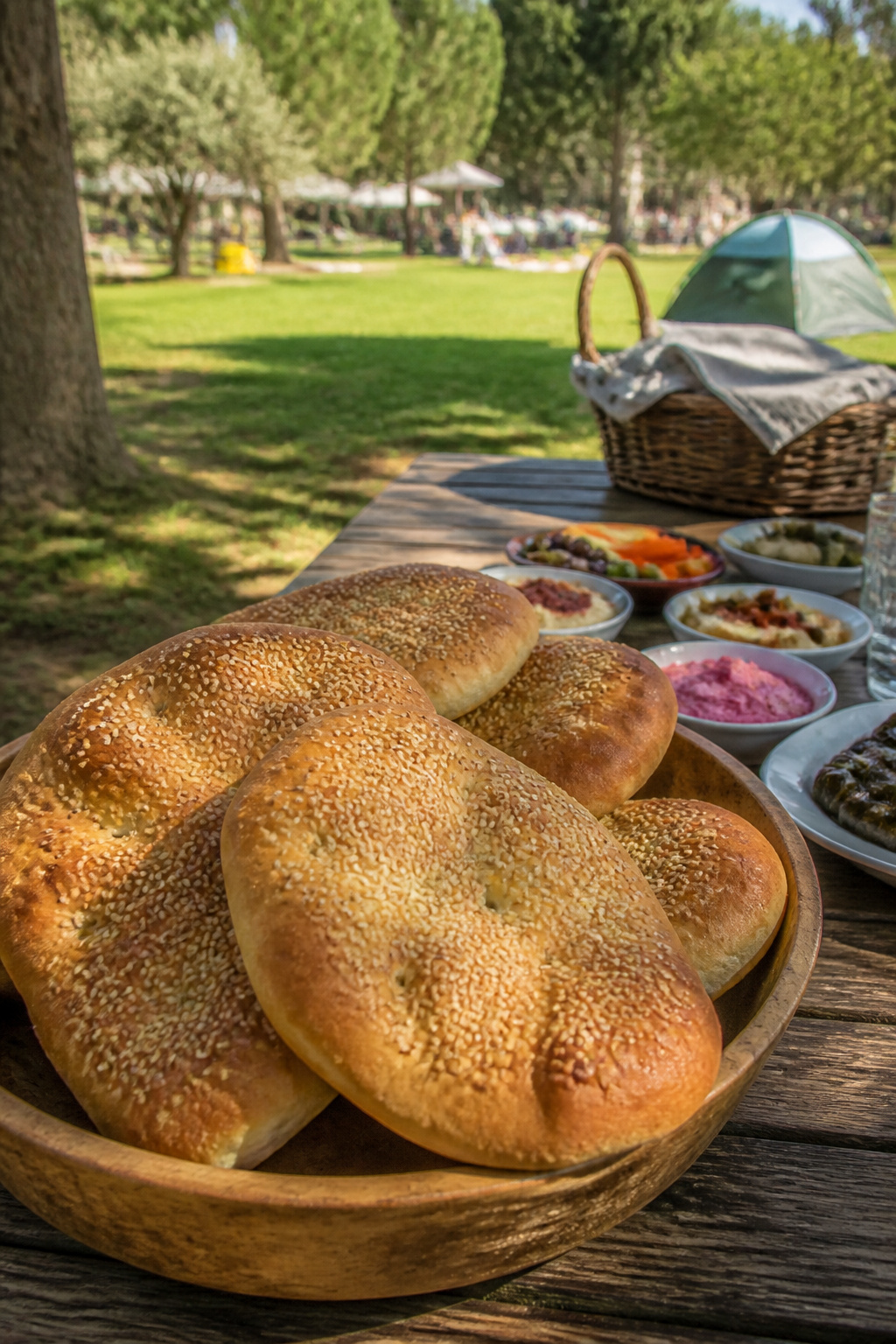
Lagana is the traditional Greek flatbread baked once a year for Clean Monday, the national holiday that kicks off Great Lent in the Orthodox calendar. That single day, Kathara Deftera, is when families picnic in parks, fly kites, and tear the bread apart by hand; knives stay in the drawer because old iron blades were thought to carry bad luck. The bread itself is a fasting food, lean by design, meant to mark seven weeks of reflection and abstinence before Orthodox Easter.
The name reaches back to ancient Greek, where "laganon" described a simple flat dough of flour and water. Aristophanes mentioned it in his Ecclesiastes with the phrase "lagana pettettai," lagans are made. Some of that ancient lineage still shows in the modern loaf: minimal crumb, crisp crust, sesame on top, and a texture built for tearing rather than slicing. In Greece, bakers work through Clean Monday morning to keep up with demand, and at home the recipe passes from parents to children as part of the same rhythm that brings out taramosalata, olives, and halva for the holiday table.
The Dough Base
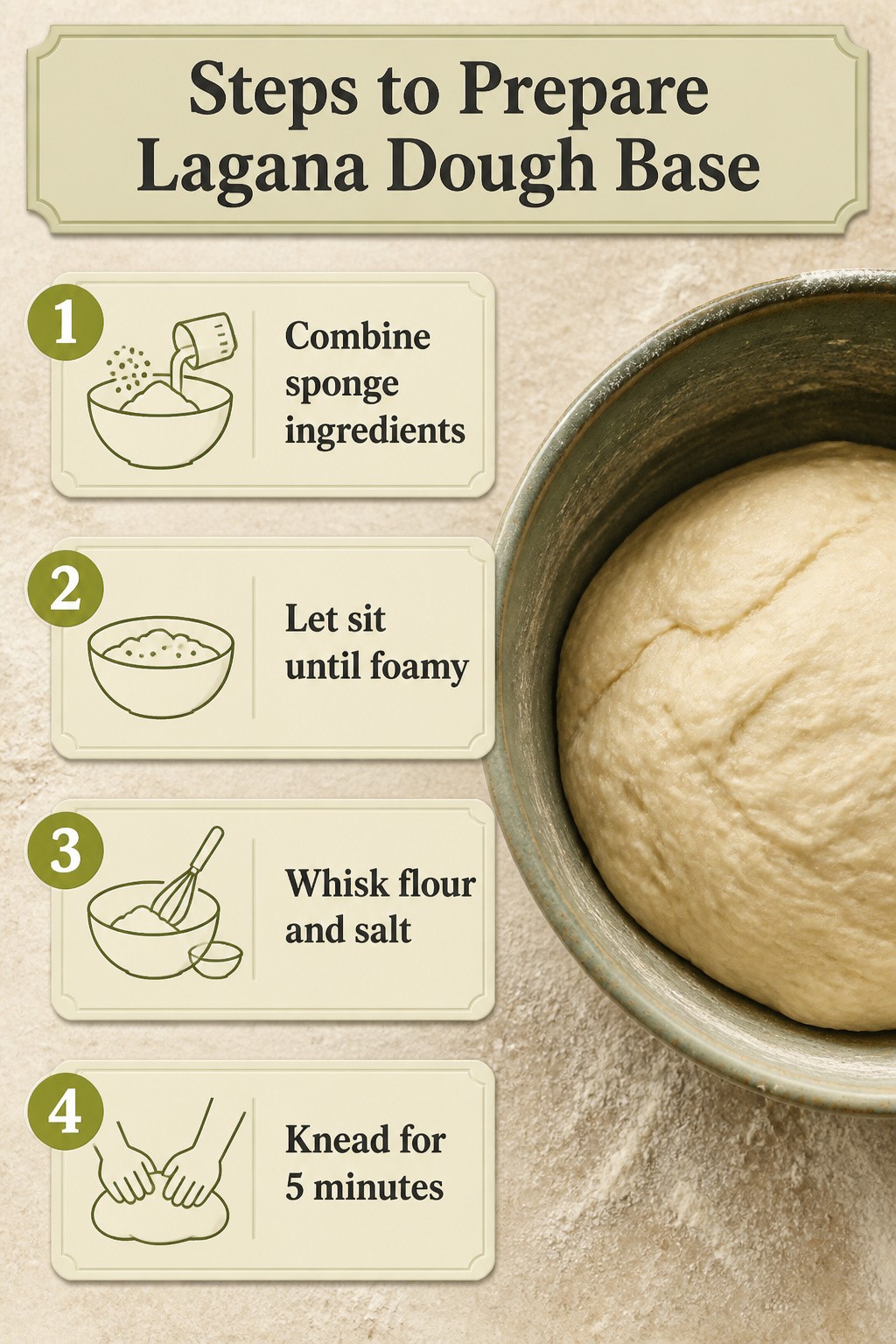
The lagana dough starts with a sponge that wakes the yeast up before the main mix goes in. Combine 1/2 cup flour, 2 tablespoons sugar, warm water, and 2 teaspoons active dry yeast in a large bowl. Let it sit about 10 minutes until the surface turns foamy; that foam means the yeast is alive and working.
Once the sponge is ready, whisk 3 1/2 cups flour with 1/2 teaspoon salt and add it to the yeast mixture. Knead for approximately 5 minutes, either by hand or with a dough hook, until the dough comes together smooth and elastic. This knead builds the gluten structure that gives lagana its characteristic chew, and stopping at five minutes keeps the dough tender rather than tough.
Working in the Oil

The dough at this stage still has a slightly rough surface, and that tablespoon of vegetable oil is what smooths it out. Pour it straight onto the dough in the bowl, then turn and fold the mass over itself for two to three minutes. The oil will slide around at first and look like it is refusing to mix in, but keep folding and pressing. Within a minute the dough starts to come together into a single, satin surface rather than a greasy slick on top of a lump.
What you are after is smooth and elastic, not greasy. If the outside still feels slick, keep working it another thirty seconds. The oil weakens the gluten network slightly, which is exactly what gives lagana its tender, almost cake-like crumb rather than the chew of a pizza crust or pita. Stop when the dough passes the windowpane test, stretches thin enough to let light through without tearing, and springs back when poked.
First Rise

- Cover the bowl and let the dough rise in a draft-free spot for about 4 hours, or until it has doubled in bulk. Most US kitchens sit between 68 and 72°F, so the timing is fairly predictable at room temperature; if yours runs cooler, the rise will stretch closer to five hours, and a warmer spot above 74°F will push it under three.
- That long, slow rise is what separates lagana from ordinary flatbread. The yeast has time to develop real flavor, and the gluten relaxes enough to give you the open, irregular crumb that makes the finished bread worth the wait. A kitchen cabinet away from the refrigerator vent works fine; so does the oven with the light on but the heat off. I set a timer for three hours first, then check every twenty minutes after that rather than guessing by the clock alone. The dough should look puffy and feel soft, not springy-tight.
Shaping the Loaves
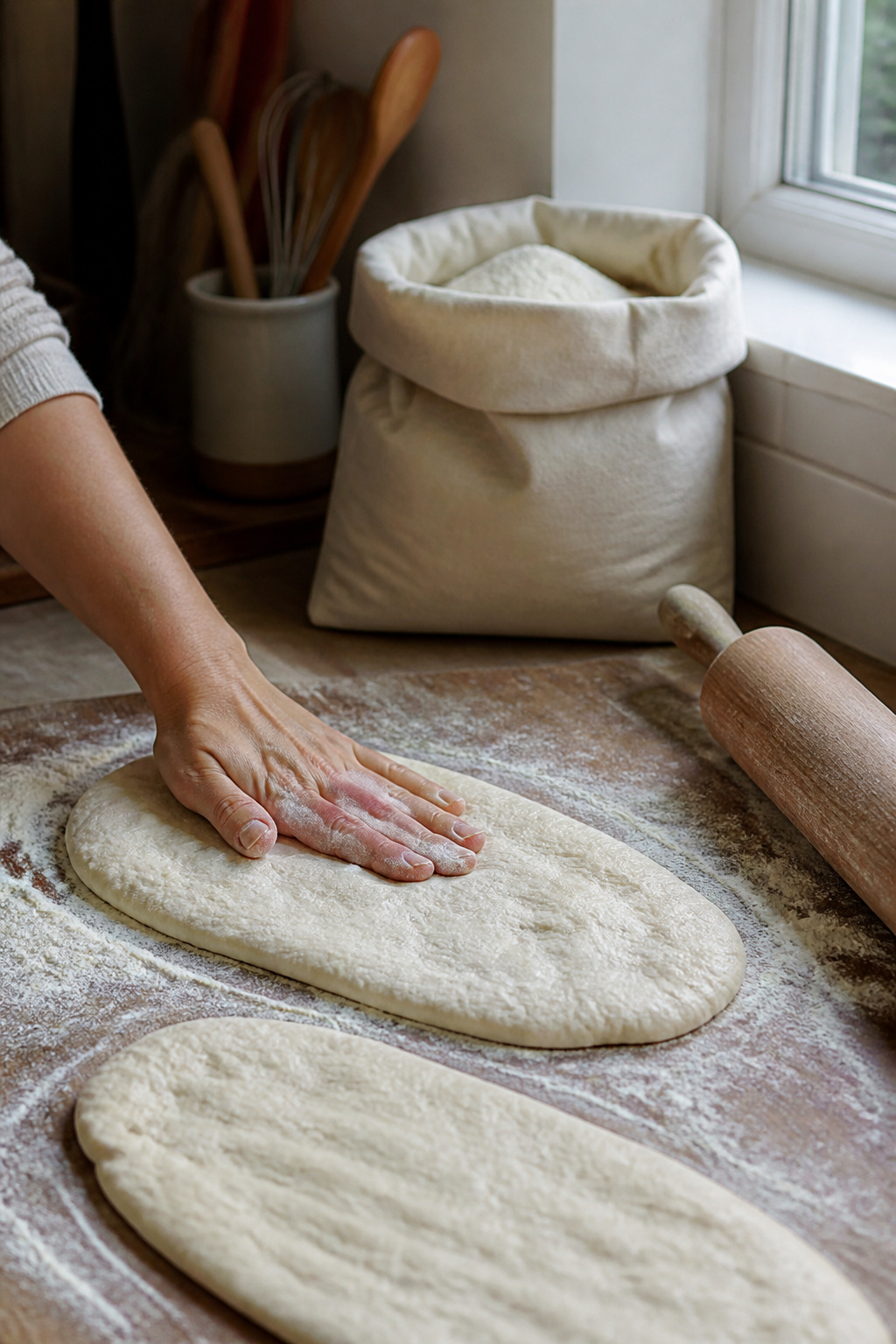
Punch the dough down in the bowl to release the air, then turn it out onto a lightly floured counter. Divide it into two equal pieces, and shape each into a ball by tucking the edges underneath. Let those balls rest for about ten minutes; the gluten relaxes, and the dough stretches without fighting back.
Working with one ball at a time, press or roll it into an elongated oval, roughly 12 inches by 7 inches and about half an inch thick. The shape should look hand-stretched and slightly uneven, not perfect like a pizza. That rustic, oblong form is what distinguishes lagana from other flatbreads. Transfer each shaped loaf to a parchment-lined baking sheet, spacing them so air circulates. If the dough springs back while you work, cover it and give it another five minutes; cold or tense dough tears instead of stretches.
Second Rise
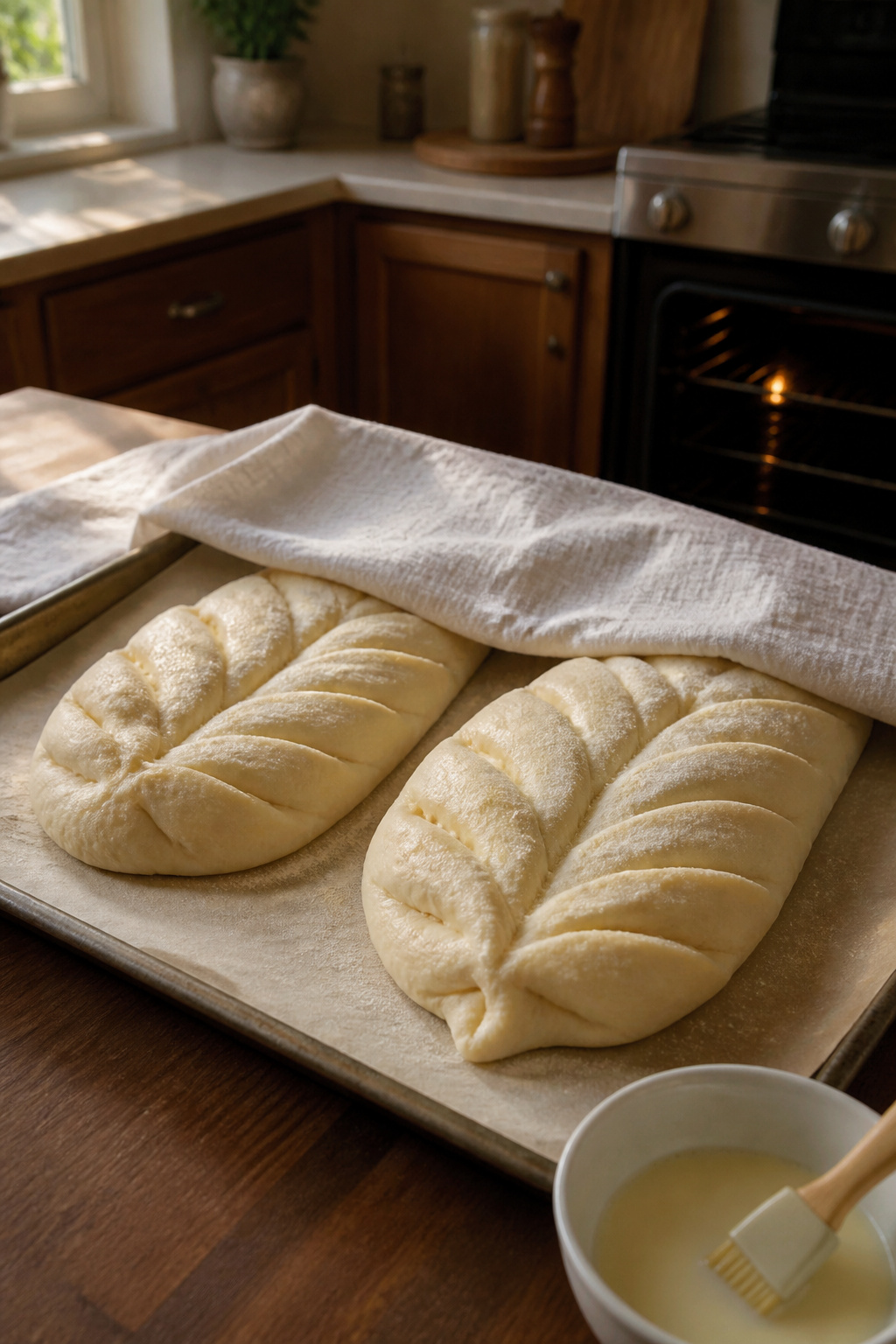
- Set the shaped loaves aside to rise again. Thirty minutes is about right. They will puff a little but stay relatively flat, which is what you want for lagana’s characteristic texture.
- While the loaves rest, preheat the oven to 350°F.
- Make the cornstarch wash. Mix 1/2 cup water with 1/2 teaspoon cornstarch. This goes on just before baking to give the crust its sheen without the egg wash that would make it too rich for Clean Monday.
Indentations and Topping

Press your fingertips deep into the surface of each loaf, spacing the indentations roughly an inch apart across the whole piece. These dents are not decoration: they let heat move through the flatbread evenly and leave little pockets that will hold olive oil once the lagana comes out of the oven.
Brush the surface with a cornstarch-water mixture. The starch acts as a light adhesive, so the sesame seeds actually stay put through the rise and bake instead of sliding off onto the pan. Scatter 2 tablespoons sesame seeds total across both loaves, pressing them gently into the wet surface with your palm.
The indentations should go in before the brushing, not after. Adding them on top of the starch layer drags the glue around and leaves bare patches where seeds will not stick.
Baking

- Slide the loaves onto the hot stone or sheet, working fast so the oven doesn’t lose its heat. Bake 20–22 minutes until the crust turns deep golden brown and the loaves sound hollow when you flip one and tap the bottom. That hollow thump is the signal the interior is cooked through, not doughy.
- Move the loaves to a wire rack and let them cool at least 15 minutes before you tear into them. The crumb is still setting inside, and cutting too early steams the texture into something gummy.
- Tear lagana into rough pieces with your hands rather than slicing it clean. The ragged edges catch oil and dips better, and the tradition of hand-torn bread matters more here than neat presentation.
Traditional and Modern Variations

The traditional lagana recipe needs only flour, water, salt, and a heavy scatter of white and black sesame seeds across the top, but the flatbread takes other flavors without much fuss. Here is where the dough changes and where the topping alone does the work:
- Sesame seed lagana: The standard. A cornstarch-and-water wash or a thin brush of honey or maple syrup helps the seeds stick through baking.
- Wholemeal flour lagana: Swap in wholemeal for part or all of the white flour. The dough will need a touch more water and a longer rest to soften the bran.
- Olive-studded lagana: Green or black olives pressed into the dough after shaping. No recipe adjustment, just fold them in gently so you do not deflate the rise.
- Sun-dried tomato lagana: Chopped sun-dried tomatoes worked into the dough the same way. Again, a topping-level change, not a structural one.
- Herb-infused lagana: Anise is the traditional choice for aroma, added to the dry ingredients. Other herbs can stand in, but anise is what marks the classic version.
- Lagana canapés: Baked, cooled, and sliced thin, then topped with taramosalata and dill, fava and octopus, or tahini and shrimp. This is a serving method, not a dough change at all.
Leftover lagana dries out fast, which is useful: cube it for olive-oil croutons baked at 200°C, grind it for aromatic breadcrumbs, or soak and squeeze it for taramokeftes or bread balls.
What to Serve With Lagana
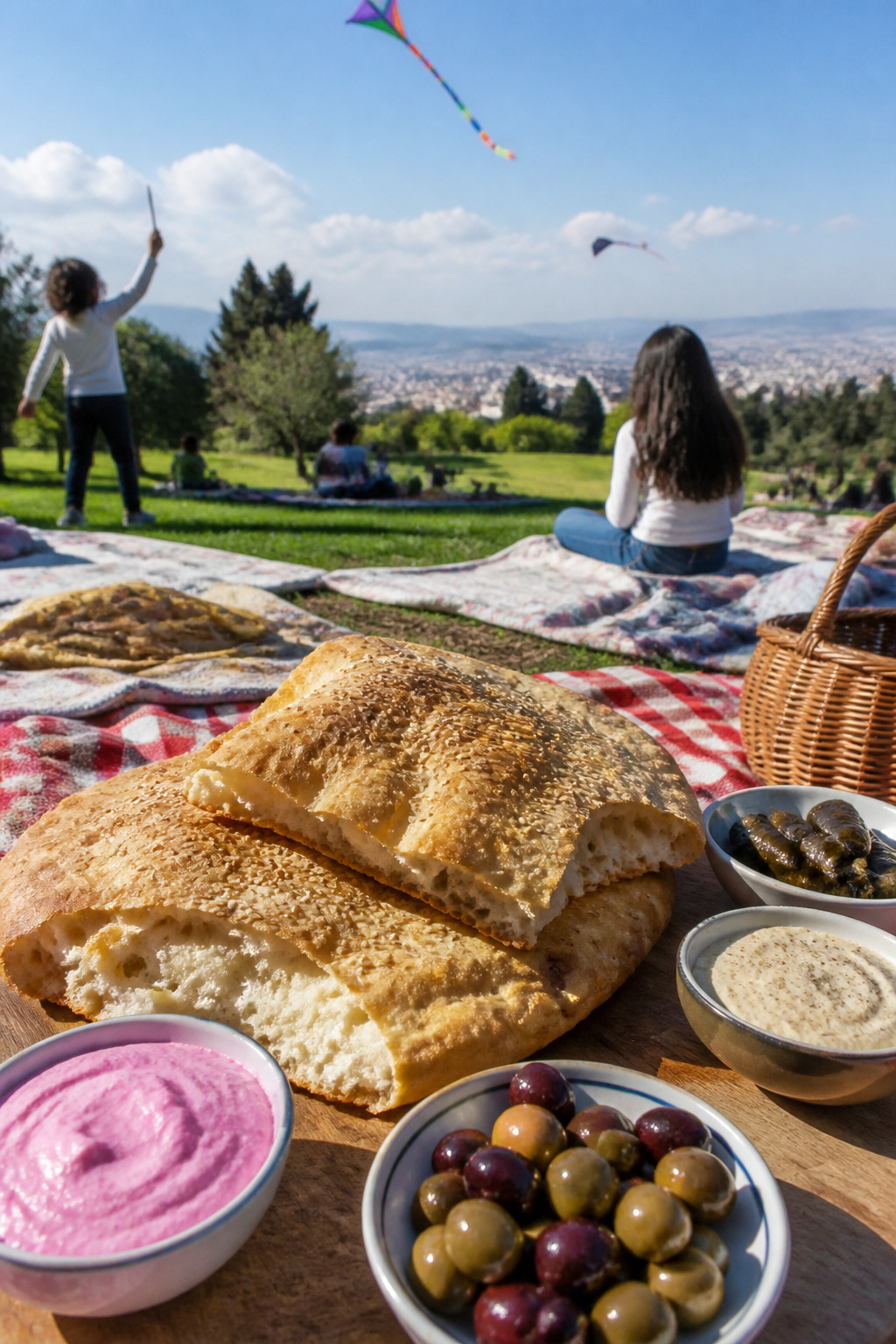
On Clean Monday, lagana is not the meal; it is the vehicle. The flatbread arrives torn by hand, not sliced, and used to scoop up whatever is on the table. Taramosalata, the fish roe dip, is the classic pairing even if it technically breaks the Lenten fast. Olives, tahini, and fava all work the same way, spread or piled and eaten with fingers.
The bread also soaks up the juices from bean soup, a standard of the day, and follows with halva for something sweet. In Greece, families take the whole spread outdoors, a picnic in parks or open ground while kites fly overhead. The lagana goes stale fast, which is why leftover pieces get cubed for croutons or ground for breadcrumbs rather than saved for another meal.
Storing and Reheating
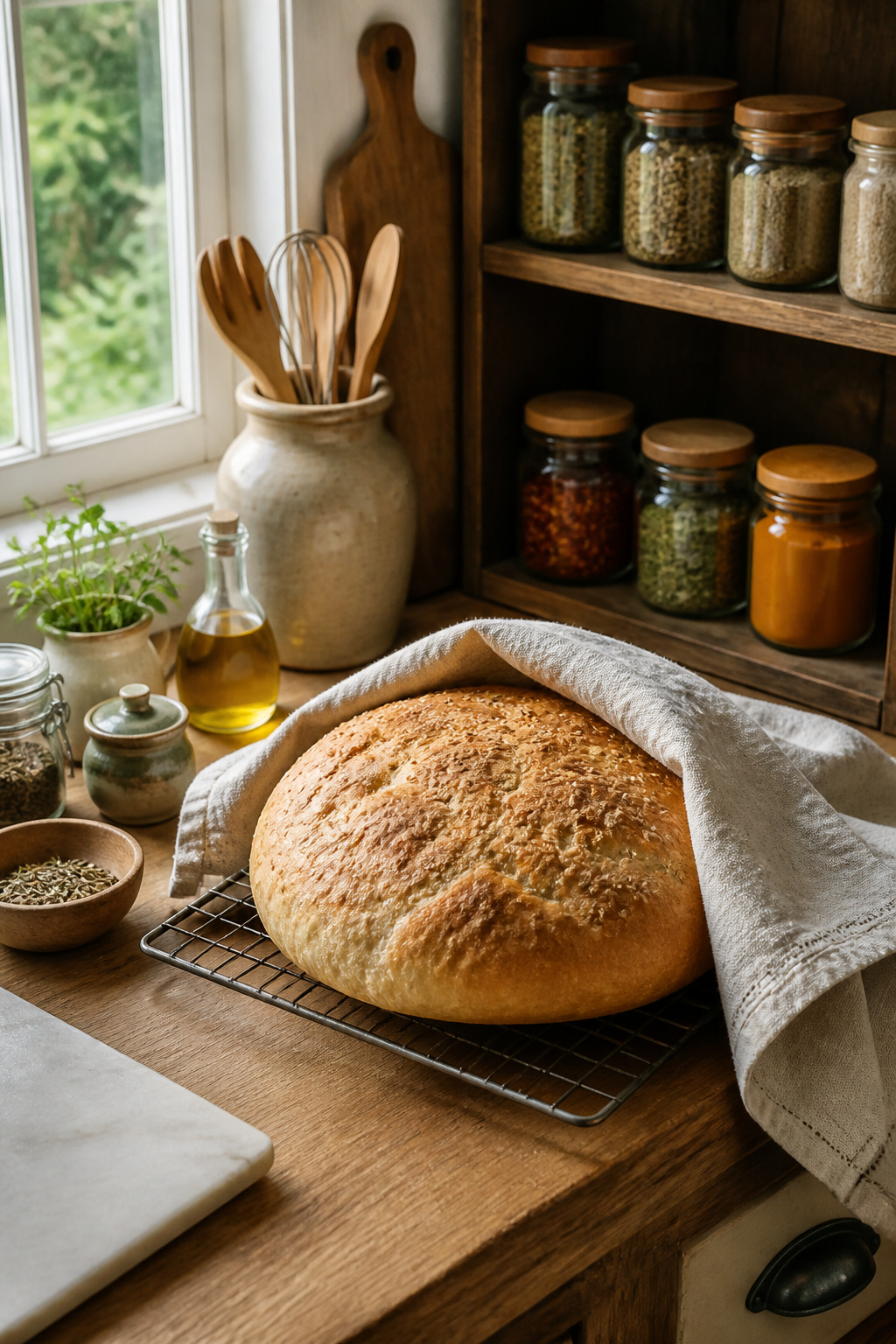
Lagana hardens and dries out quickly, so the day it is baked is the day to eat it. For anything left over, do not refrigerate; the cold air pulls moisture from the crumb faster than room temperature and the bread turns stale within a day.
Freezing is the only advance option that holds up. Cool the loaf completely first, then wrap it tight in plastic and again in foil. Stored this way, it keeps for up to one month. Thaw it at room temperature, then refresh in a 350°F oven for 5–7 minutes. The crust comes back crisp, the interior soft enough to tear.
Traditional vs. Modern Methods
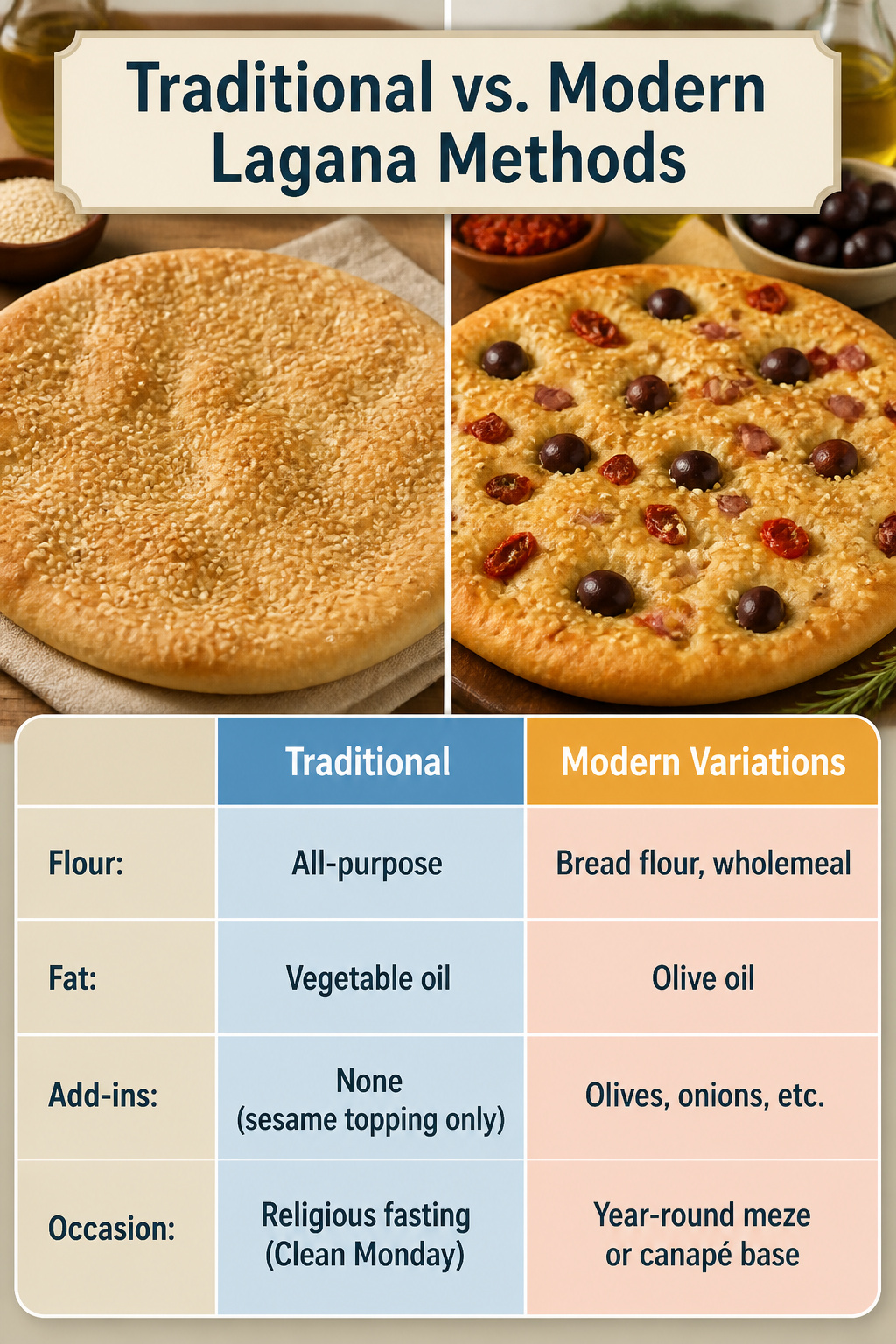
The lagana I grew up with came out soft and pliable, almost tender, from all-purpose flour and vegetable oil baked at a moderate heat. That mild oil made sense for Clean Monday fasting, when some households skip olive oil entirely. Modern versions swap in bread flour for chewier crumb, or fold in olives, sun-dried tomatoes, pepper, and onion right into the dough. Olive oil works too, though the flavor is more pronounced.
| Attribute | Traditional | Modern Variations |
|---|---|---|
| Flour | All-purpose | Bread flour, wholemeal |
| Fat | Vegetable oil | Olive oil |
| Add-ins | None (sesame topping only) | Olives, sun-dried tomatoes, onion, pepper |
| Occasion | Religious fasting (Clean Monday) | Year-round meze or canapé base |
What started as a once-a-year bread for the fasting table now shows up sliced thin for canapés, cubed into croutons, or ground into galette after it dries. The shift is practical: a soft, oil-enriched dough handles repurposing better than leaner breads, so the same recipe earns its keep beyond the single holiday.
Frequently Asked Questions
What is lagana?
Lagana is the traditional Greek flatbread baked once a year for Clean Monday, the holiday that starts Great Lent in the Orthodox calendar. It is a lean, fasting bread made from a simple dough of flour, water, yeast, salt, and a touch of sugar, then topped with sesame seeds. The bread is always torn by hand rather than sliced, and knives stay in the drawer because old iron blades were thought to carry bad luck.
How do you make lagana?
Start with a sponge of 1/2 cup flour, 2 tablespoons sugar, warm water, and 2 teaspoons active dry yeast; let it foam for about 10 minutes. Mix in 3 1/2 cups flour and 1/2 teaspoon salt, then knead for 5 minutes until smooth. Work in 1 tablespoon vegetable oil until the dough is satin and elastic, not greasy. Let it rise 4 hours until doubled, shape into two rustic ovals, proof 30 minutes more, then indent with fingertips, brush with cornstarch wash, scatter sesame seeds, and bake at 350°F for 20–22 minutes.
What can I serve with lagana?
Lagana is built for scooping and tearing, so it pairs with spreads and dips rather than standing alone. Taramosalata, the classic fish roe dip, is the traditional choice even if it technically breaks the Lenten fast. Olives, tahini, fava, and bean soup all work well, and halva follows for something sweet. Leftover lagana dries fast, so cube it for croutons or grind it for breadcrumbs rather than saving it for another meal.